Before machines could read a product, every price and every inventory count depended on a human being looking, remembering, and writing it down. Grocery clerks keyed in prices by hand at the register, warehouse staff tallied stock on clipboards, and retailers often had only a rough sense of what was actually on their shelves until someone physically counted it. The idea of a machine-readable label that could carry information about an item seems obvious in hindsight, but it took decades of fragmented experimentation, several competing technical standards, and a retail industry desperate to speed up checkout lines before it became the backbone of global product tracking it is today.
Early Experiments and the Push for Standardization
The earliest documented proposal for a machine-readable code is generally traced to Bernard Silver and Norman Joseph Woodland, who in the late 1940s began experimenting with ways to encode product information so it could be scanned automatically; they filed a patent for a bullseye-shaped pattern in 1949. Their work was, in its own time, a curiosity more than a commercial product, since the scanning technology needed to read such codes reliably did not yet exist. In the following decades, a separate and largely independent effort emerged in freight railroading, where companies developed a system called KarTrak in the 1960s to identify railcars automatically as they passed trackside scanners, an early sign that automated identification had value well beyond the supermarket.
It was the grocery industry, facing rising labor costs and competitive pressure to speed up checkout, that finally pushed the technology toward a true standard. A U.S. grocery industry committee worked through the early 1970s to settle on a single format, and the Universal Product Code, developed with substantial input from engineer George Laurer at IBM building on the earlier bullseye concept, was formally adopted in 1973. Many sources cite June 26, 1974, as the date a pack of Wrigley's chewing gum became the first UPC-coded product scanned at a retail checkout, at a Marsh supermarket in Troy, Ohio, though the broader rollout across stores and manufacturers took years to complete.
The UPC and the Retail Revolution
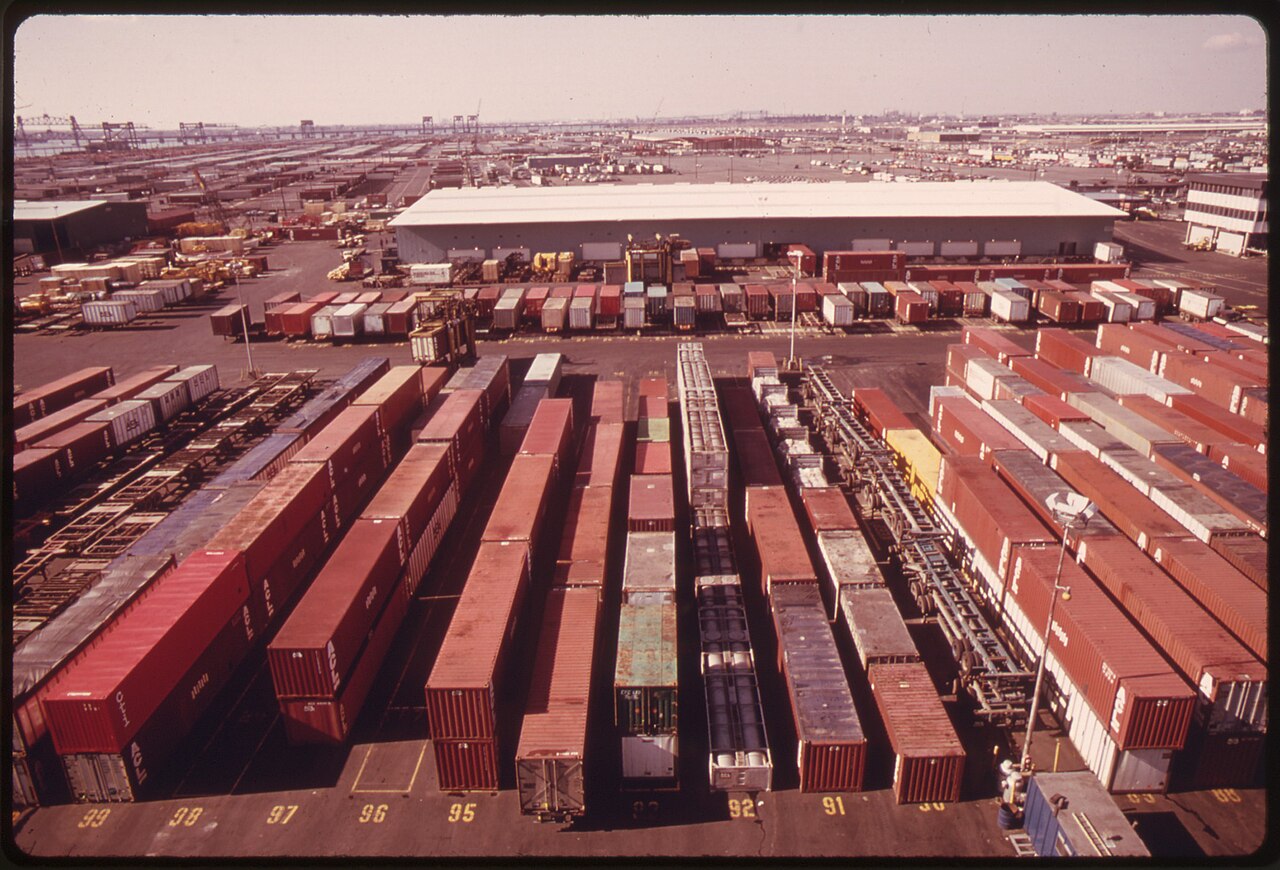
Once retailers and manufacturers agreed on a shared code, barcoding spread quickly beyond the checkout counter. Supermarkets and department stores used scanner data not just to ring up sales but to track which products were selling, triggering automatic reorders and reducing the guesswork in stocking shelves. Large retail chains, most notably Walmart, built sophisticated logistics operations around barcode data, linking what sold at the register directly to what moved through distribution centers and, eventually, what needed to be shipped from suppliers. The technology also moved into shipping and freight more broadly, with package carriers like UPS adopting barcode labels to track parcels as they moved through sorting facilities, complementing the standardized shipping containers and air cargo networks carrying global trade. Self-checkout kiosks, which began appearing in supermarkets in meaningful numbers during the 1990s and spread widely in the following two decades, depended entirely on reliable barcode scanning to let customers ring up their own purchases, a development that further reduced the number of cashier positions a typical large store required even as it added a new category of self-service retail work. Adoption was never confined to the United States. European retailers and manufacturers developed a compatible standard, the European Article Number, in 1976, and the organization now known as GS1 eventually brought these numbering systems together into a single global framework used by retailers and suppliers in well over a hundred countries. That international standardization mattered enormously for trade, since it meant a product barcoded in one country could be read, tracked, and reconciled with inventory systems anywhere else in the world, smoothing the cross-border logistics that container shipping and air freight depended on. Later innovations, including two-dimensional QR codes, introduced in Japan in 1994 and capable of holding far more information than a traditional linear barcode, and radio-frequency identification tags that can be read without a direct line of sight, extended the same basic idea: giving a physical object a machine-readable identity that could be tracked automatically at every point in its journey. These newer technologies have also strengthened food safety recalls and pharmaceutical anti-counterfeiting programs, letting regulators trace a contaminated or fraudulent product back through a supply chain far more quickly than manual recordkeeping ever allowed.
Winners and Losers in an Automated System
The efficiency gains were substantial and widely documented. Faster checkout reduced labor costs and customer wait times, more accurate inventory tracking cut down on both stockouts and overstock waste, and the detailed sales data barcodes generated let retailers and manufacturers respond to shifting demand far more precisely than before. Many economists credit this kind of inventory precision with helping to lower consumer prices over time by reducing waste throughout the supply chain.
These gains were not distributed evenly. The scanning systems and point-of-sale infrastructure required real capital investment, which larger chains could afford far more easily than small independent retailers, arguably widening the competitive gap between big-box stores and neighborhood shops. The same data that made inventory management more efficient also made it possible to monitor workers more closely: warehouse and retail employees have long been evaluated, and in many documented cases penalized, based on scan rates and handling speed, a practice that labor advocates have criticized as a harsh form of workplace surveillance. Barcodes also transformed the kind of information companies could collect about consumer purchasing habits, raising privacy questions that intensified as that data was later combined with loyalty programs and, eventually, online shopping profiles. And the automation that streamlined checkout and stocking also reduced the number of workers needed for tasks like manual price-tagging and inventory counts, part of a broader pattern of retail labor displacement that unfolded over several decades. Counterfeiters, for their part, adapted quickly as well, and investigators have documented cases of fraudulent barcodes used to mislabel goods or disguise the true origin of a shipment, showing that even a technology designed to improve transparency can be turned against it when oversight is weak.
Lasting Significance for Global Trade
Barcodes rarely attract the attention given to ships, airplanes, or the internet in histories of global trade, yet they solved a problem just as fundamental: knowing, instantly and automatically, what a product is and where it has been. That capability underpins nearly every modern supply chain, from a single grocery store to the sprawling fulfillment networks behind global e-commerce. More than fifty years after the first scan of a pack of gum in Ohio, the basic logic of the barcode, now joined by QR codes and RFID tags, remains one of the quiet but indispensable technologies of modern logistics. To see how this fits alongside other innovations of the period, visit the modern logistics era on our timeline.