For most of maritime history, moving cargo across an ocean meant moving it one piece at a time. Sacks of coffee, bales of cotton, crates of machinery, and barrels of oil were carried up gangplanks, stacked by hand in a ship's hold, and later unloaded the same way at the far end of the voyage. This system, known as break-bulk shipping, was slow, labor-intensive, and expensive. A ship might sit idle in port for a week or more while longshoremen loaded and unloaded it, and theft and damage to loose cargo were routine costs of doing business. Shipping, for centuries, was as much about brute labor as it was about navigation.
The idea of moving freight in standardized boxes was not invented all at once, and it did not come from a single source. Railroads in Britain and the United States experimented with removable cargo containers as early as the nineteenth century, and European freight lines tried various box and pallet systems in the early twentieth century. The U.S. military also played an important role, developing standardized steel containers known as CONEX boxes to move supplies during the Korean War in the early 1950s. These earlier efforts proved that containerized freight could work, but none of them created a fully integrated system linking ships, trucks, and ports.
From the Ideal X to a Global Standard
The event most often cited as the breakthrough came in April 1956, when American trucking entrepreneur Malcolm McLean loaded fifty-eight modified truck trailers onto a converted tanker, the Ideal X, and sailed it from Newark, New Jersey, to Houston, Texas. McLean's real contribution was not the shipping container itself but the business model behind it: he reorganized his companies so that the same box could move seamlessly from truck chassis to ship to another truck, cutting out the repeated handling of loose cargo. It is worth noting, as many historians do, that McLean built on ideas and technology that were already circulating rather than inventing the concept from nothing.
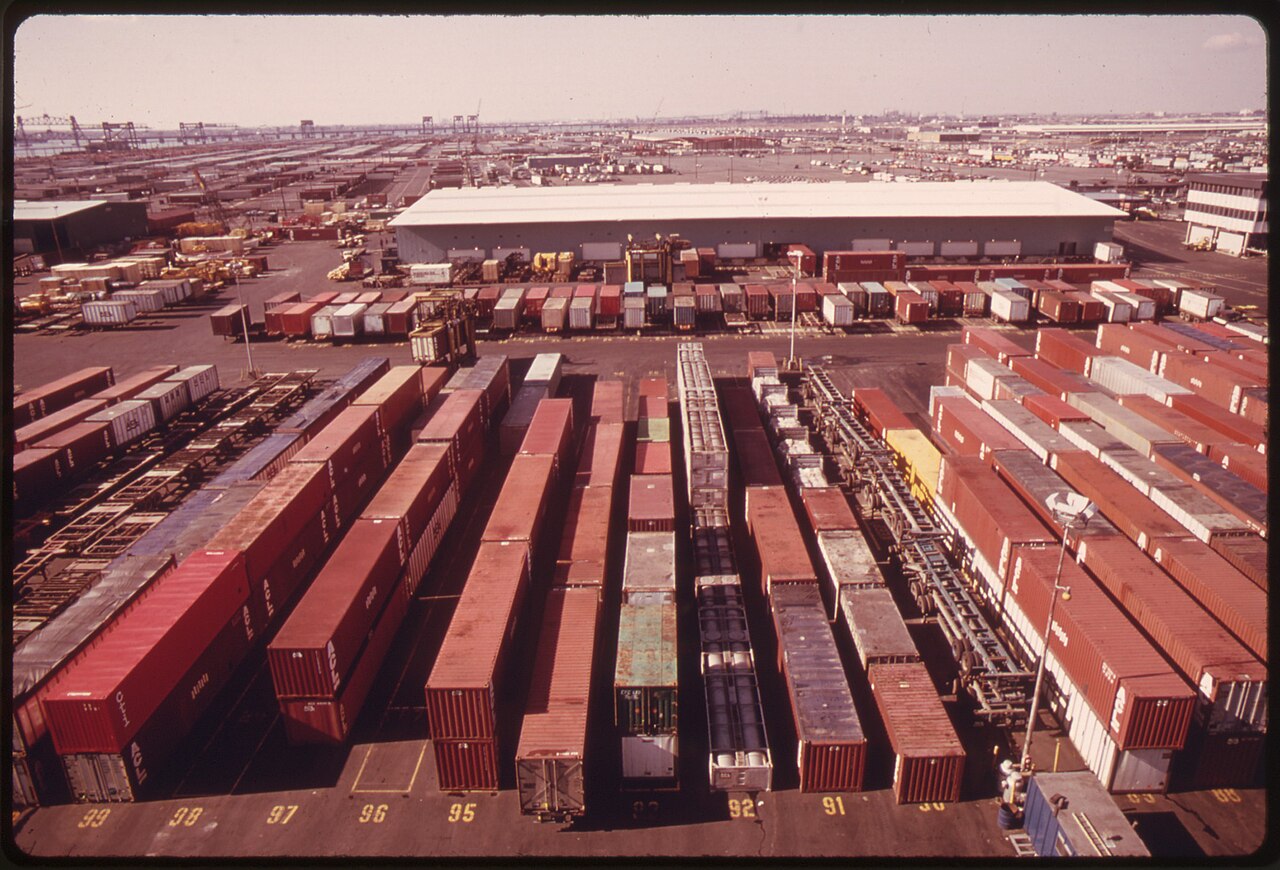
The years that followed were less about any single innovation and more about standardization. Through the 1960s, shipping lines, port authorities, and engineers debated competing container sizes until the International Organization for Standardization settled on dimensions—chiefly the 20-foot and 40-foot "TEU" boxes still used today—along with standardized corner castings that let cranes and ships lock containers securely in place. The Vietnam War gave the system an early large-scale test, as the U.S. military used Sea-Land's container ships to supply troops, demonstrating the model's efficiency. By the 1970s, major ports from Rotterdam to Kobe had begun investing in the gantry cranes and rail yards needed to handle containers at scale, and the old finger piers built for break-bulk cargo were rapidly becoming obsolete.
Reshaping Global Manufacturing and Labor
The economic effects were enormous. Containerization sharply reduced the cost and time of moving goods across oceans, and some economic historians argue it did more to accelerate global trade in the late twentieth century than any tariff agreement. Cheaper, faster, more predictable shipping made it practical for companies to separate design, manufacturing, and assembly across different continents and still deliver finished goods on a reliable schedule. This logistical shift helped make possible the rise of East Asia, and later China, as the world's dominant manufacturing region, and it underpinned the "just-in-time" inventory strategies that many large retailers and manufacturers now depend on.
That transformation did not benefit everyone equally. Containerization dramatically reduced the number of dockworkers needed to load and unload a ship, since a single crane operator could now move cargo that once required dozens of laborers. Longshore unions in the United States and elsewhere fought hard, and with some success, to secure job guarantees and a share of the productivity gains for remaining workers, but port employment never returned to its break-bulk-era levels. At the same time, manufacturing jobs in parts of North America and Western Europe declined as production shifted toward regions offering lower labor costs, a dislocation that container shipping did not cause on its own but substantially enabled. Special economic zones such as Shenzhen, established in China beginning in 1980, grew explicitly around the logic of containerized export manufacturing, turning what had been a fishing town into one of the world's largest industrial and port complexes within a generation.
Automation has continued to reshape port labor long after the original shift from break-bulk cargo. Terminals in Rotterdam, Qingdao, and Long Beach have increasingly adopted automated gantry cranes and driverless yard vehicles that move containers with minimal direct human operation, a trend that port operators present as a way to improve safety and throughput but that labor unions have frequently resisted as a further threat to dockworker jobs. Meanwhile, the sailors who crew container ships, many recruited from the Philippines, Indonesia, and other countries with large seafaring workforces, often work under long contracts and the legal arrangements known as flags of convenience, which let shipowners register vessels in countries with lighter labor and safety regulation than their home markets. Maritime labor advocates have long argued that this system allows working conditions at sea to lag behind the standards applied in most other industries, even as those same ships make the rest of global retail possible.
Environmental and Systemic Costs
Modern container ships also carry a significant environmental burden. The largest vessels burn heavy bunker fuel and emit substantial amounts of sulfur, particulate matter, and greenhouse gases, prompting the International Maritime Organization to introduce emissions rules in recent years. Ballast water and hull fouling on these ships have also spread invasive species between ecosystems that were once separated by ocean distances. And because so much of world trade now flows through a relatively small number of mega-ports and canals, the system is vulnerable to disruption: the 2021 grounding of the container ship Ever Given in the Suez Canal, and the severe port congestion that followed the COVID-19 pandemic, both showed how a single chokepoint or shock can ripple through supply chains worldwide.
Lasting Significance for Global Trade
Despite these strains, containerized shipping remains the circulatory system of world trade; the World Shipping Council and other industry groups estimate that the large majority of manufactured goods traded internationally move in containers at some stage of their journey. It works alongside other twentieth-century logistics innovations explored elsewhere on this site, including air freight for high-value, time-sensitive goods and the barcode systems that track cargo once it reaches land. More than sixty years after the Ideal X's first voyage, the humble steel box remains one of the most consequential and least celebrated inventions in the history of trade. For a broader look at how these technologies fit together, see the modern logistics era on our timeline.