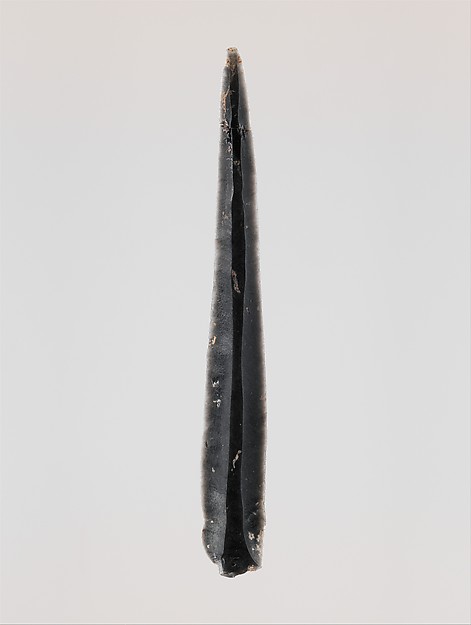
Centuries before the invention of writing, pottery, or even permanent farming villages, people were already moving a remarkable material across vast distances: obsidian, a naturally occurring volcanic glass that fractures into edges sharper than surgical steel. Archaeologists have traced pieces of obsidian recovered from ancient settlements back to specific volcanic outcrops sometimes located hundreds of miles away, using a technique called geochemical sourcing. Those findings point to the existence of exchange networks that many researchers consider among the oldest documented trade systems anywhere in the world. Importantly, these networks did not develop in just one place. Independent obsidian trade systems arose in at least three widely separated regions, Anatolia and the Near East, Mesoamerica, and the islands of the Pacific, each shaped by local geography, social organization, and need, long before these societies had any contact with one another.
Anatolia's Volcanic Glass and the Neolithic Exchange Web
In the uplands of what is now central and eastern Turkey, volcanic peaks such as Goellue Dag and Nenezi Dag produced obsidian that moving communities carried, traded, or passed hand to hand across the Fertile Crescent. Many archaeologists estimate that this exchange was already underway by the ninth or tenth millennium BCE, based on obsidian finds at early Neolithic sites including Catalhoeyuek in Anatolia and settlements in the Levant and northern Mesopotamia. Some researchers argue that the famous carved stone enclosures at Goebekli Tepe, generally dated to the tenth millennium BCE, may reflect the kind of large seasonal gatherings that could have helped sustain these early long-distance ties, though the connection between ritual gathering sites and material exchange remains debated. The distances involved were substantial for people traveling largely on foot: obsidian from central Anatolian sources has turned up in Cyprus and the southern Levant, areas separated from the quarries by well over 500 miles of mountain, sea, and desert.
Because obsidian held clear practical value for cutting tools, scrapers, and projectile points, and because its source could be chemically fingerprinted to a specific volcanic flow, it has become one of archaeology's most useful tracers for mapping how early communities interacted. Scholars generally caution that the presence of obsidian at a site does not by itself prove organized long-distance trade in the modern sense; it could also reflect gift exchange, seasonal mobility, or chains of short hand-offs between neighboring groups rather than a single trader traveling the whole distance.
Independent Obsidian Networks in Mesoamerica
A broadly similar pattern developed, apparently without any connection to events in the Near East, across Mesoamerica. Obsidian flows around the Valley of Mexico, in the Guatemalan highlands, and elsewhere supplied material that moved across what are now Mexico, Guatemala, Belize, and Honduras for thousands of years. Sourcing studies on obsidian recovered from Maya and earlier Olmec-era sites show that specific quarries, such as those at El Chayal and San Martin Jilotepeque in highland Guatemala, supplied workshops and households many hundreds of miles from the source.
By the time of the Classic Maya period, many historians estimate roughly 250 to 900 CE, obsidian blades, used for everything from woodworking to bloodletting rituals, moved through networks that also carried cacao, jade, feathers, and salt. Later, the Aztec Empire organized long-distance exchange through both tribute obligations and professional long-distance merchants known as pochteca, who carried obsidian alongside other valuable goods across central Mexico. The deep antiquity of obsidian exchange in this region, extending back well before any of these later states existed, shows that complex trade behavior emerged independently in the Americas rather than diffusing outward from the Old World.
Island-Hopping Trade Across the Pacific
A third, entirely separate obsidian network developed in the southwestern Pacific. Archaeologists working in Papua New Guinea and the Bismarck Archipelago have traced obsidian from sources on islands such as New Britain and Manus to sites more than 1,000 miles away, across open ocean, carried in part by the Lapita cultural tradition associated with the ancestors of many Pacific Island peoples. Many researchers date the beginnings of this maritime exchange to roughly 3,000 to 3,500 years ago, though some obsidian movement in the wider New Guinea region appears to stretch back considerably further, with a few studies pointing to exchange tens of thousands of years into the past, among some of the oldest known evidence anywhere for watercraft-based trade.
This Pacific network required a skill set entirely different from the overland routes of Anatolia or Mesoamerica: seaworthy canoes, navigational knowledge, and the ability to sustain social relationships across island communities separated by open water. That these mariners developed reliable long-distance exchange with only simple craft underscores how widely, and how independently, the practice of trading obsidian took root around the globe.
What Obsidian Sourcing Reveals, and What It Cost
The study of ancient obsidian exchange has given archaeologists an unusually precise window into prehistoric social life, because the chemical signature of each volcanic source can usually be matched to a specific flow using methods such as X-ray fluorescence. This has allowed researchers to map contact between communities who left no written records at all, revealing networks of cooperation, kinship, and perhaps early forms of specialization long before cities or states existed.
At the same time, historians caution against romanticizing these networks. Control over desirable obsidian outcrops likely became a source of local advantage and, in some cases, friction between groups, and some archaeologists have suggested that access to prized quarries contributed to emerging social inequality in later Neolithic communities. Quarrying also altered the immediate landscape around major obsidian sources, and increasing demand over time likely placed pressure on the communities nearest the outcrops to continually extract and prepare material for others. These are modest costs compared to the large-scale exploitation seen in later trade systems, but they are a reminder that even the earliest exchange networks carried social and environmental consequences alongside their evident benefits.
The Lasting Significance of the Oldest Trade Routes
Obsidian exchange matters to trade history not because of the material's rarity today, but because of what it proves about human behavior deep in prehistory. It shows that long before agriculture, writing, or permanent cities became widespread, people in multiple unconnected regions of the world were already capable of organizing exchange across vast distances, sustaining relationships with distant and unfamiliar communities, and valuing goods for qualities beyond immediate survival. The methods archaeologists developed to trace obsidian have since been applied to other prehistoric materials, shaping how historians understand the deep origins of trade. For a broader look at how exchange evolved in the millennia that followed, see the early exchange era timeline, and for a comparison with later, resource-driven trade empires, see Trade and Tribute in Ancient Mesopotamia.