Before the mid-nineteenth century, commercial information traveled no faster than a ship, a horse, or a human courier could carry it. A merchant in London learning of a price shift in New York might wait weeks for the news to arrive by sailing packet, by which time the opportunity to act on it had often passed. The development of electric telegraphy, which drew on decades of scientific work in electromagnetism by researchers across Europe and North America, compressed that lag from weeks to minutes, and in doing so altered the rhythm of trade as fundamentally as railroads and steamships were altering its physical movement of goods.
Telegraphy's origins involved multiple contributors rather than a single inventor. Scientists including Hans Christian Ørsted, André-Marie Ampère, and Michael Faraday advanced the understanding of electromagnetism that made signaling possible, while practical telegraph systems were developed independently and in parallel by figures such as William Fothergill Cooke and Charles Wheatstone in Britain and Samuel Morse, working with Alfred Vail, in the United States during the 1830s and 1840s. Morse and Vail's code, which assigned combinations of short and long pulses to letters, became the dominant standard in much of the world, though competing systems persisted in some regions for years. Many historians stress that crediting telegraphy to any one person oversimplifies a technology that emerged from overlapping research traditions and commercial rivalries.
Wiring a Continent, Then the World
Commercial telegraph lines spread quickly once their value became apparent. In the United States, lines linked major cities by the late 1840s, and the Western Union Telegraph Company, formed in 1851 and expanded through subsequent mergers, became the dominant domestic carrier, completing a transcontinental line in 1861 that effectively ended the short-lived Pony Express mail service almost overnight. Britain and continental Europe built dense networks over similar timeframes, often with close ties between telegraph companies and railway operators, since rail rights-of-way provided convenient routes for stringing wire, a relationship touched on further in railroads and the expansion of inland trade.
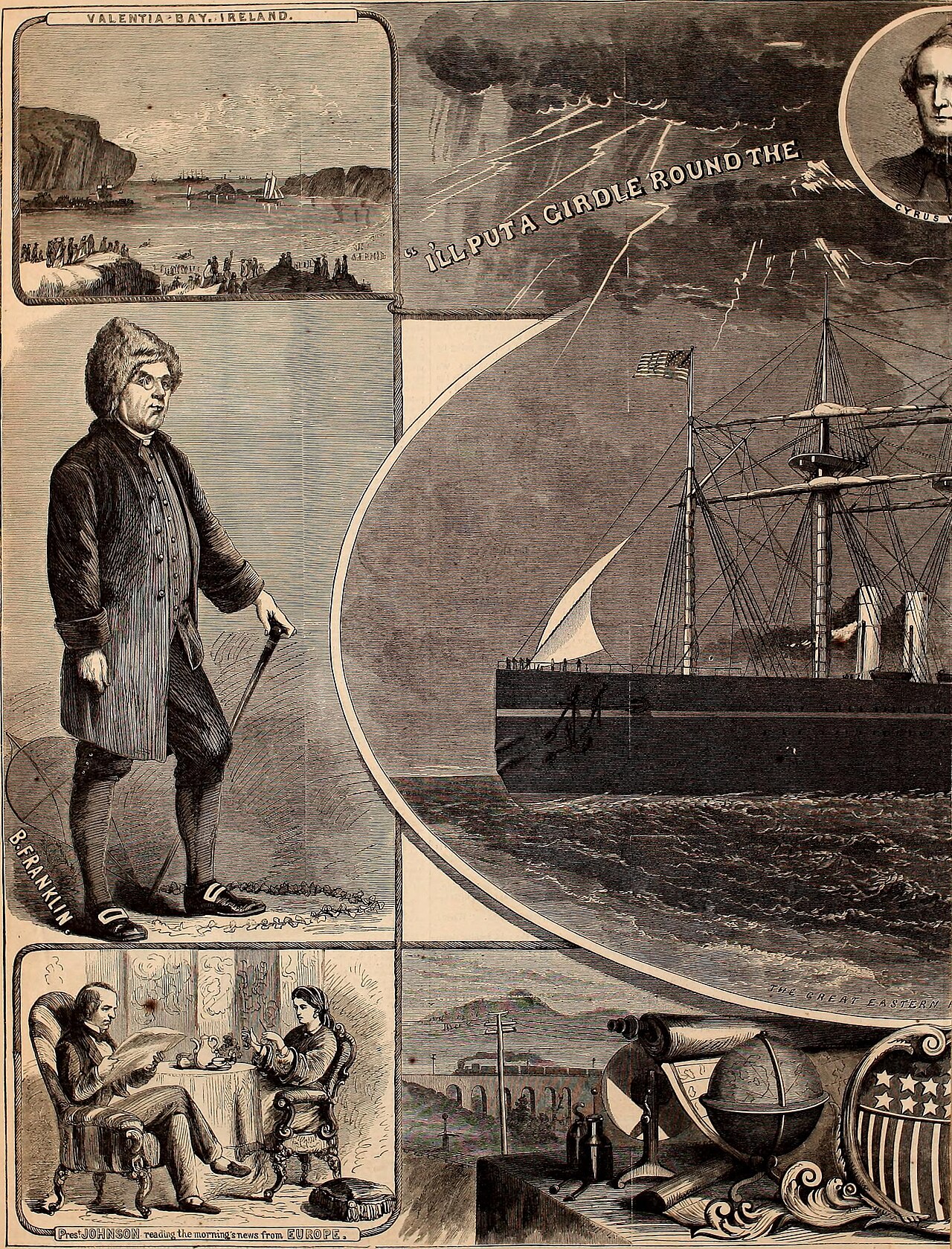
The more consequential challenge was connecting continents. Submarine cable-laying required insulation materials, principally gutta-percha, a latex derived from Southeast Asian trees, along with specialized cable-laying ships and immense capital investment. Early transatlantic attempts failed or functioned only briefly; a cable completed in 1858 operated for a few weeks before failing, and a durable transatlantic connection was not achieved until 1866. From there, cable networks extended to connect Europe with India, East Asia, Australia, and eventually most of the inhabited world by the early twentieth century, often financed and controlled by British firms that maintained a dominant position in global cable infrastructure for decades.
Markets, Prices, and the Speed of Decision-Making
For commerce, the telegraph's most immediate effect was on information itself becoming a tradeable, time-sensitive commodity. Commodity exchanges in Chicago, New York, Liverpool, and elsewhere could now receive price information from distant markets within the same day, which tended to narrow regional price gaps for staples like cotton, wheat, and precious metals, since arbitrage opportunities that once lasted weeks might close within hours. Merchants could issue and confirm orders, adjust shipments still at sea, and settle disputes far faster than before. News agencies, including Reuters, founded in the early 1850s, built business models specifically around selling fast commercial and political news to subscribers, reflecting how quickly information speed itself became a commercial product.
Because telegram costs were charged by the word, merchants and brokers developed elaborate commercial codebooks that compressed common phrases, prices, and instructions into single code words, reducing expense while also protecting sensitive business terms from casual observers along the line. These codebooks became specialized trade tools in their own right, published and revised by shipping firms, banks, and commodity brokers, and some remained in commercial use well into the twentieth century even after rates declined. The practice illustrates how thoroughly businesses reorganized their internal communication habits around the economics of the new medium, treating concise, unambiguous phrasing as a competitive skill much as speed and reliability were becoming competitive advantages in shipping and rail freight.
This speed was not evenly distributed. Access to telegraph service was expensive relative to average incomes, meaning that large firms, banks, and well-capitalized traders benefited disproportionately over small merchants and farmers who could not easily afford frequent telegrams. Regions without telegraph connections, including much of rural Africa, interior Asia, and other areas peripheral to colonial and commercial networks, remained at an informational disadvantage well into the twentieth century, reinforcing existing economic hierarchies rather than leveling them. Telegraph operators themselves, a workforce that included many women by the later nineteenth century, often worked long hours under pressure for modest wages, and the operator's skill in Morse code became a specialized, somewhat precarious occupation vulnerable to later automation.
Geopolitics, Control, and Vulnerability
Because so much of the global cable network passed through British-controlled relay points and was financed by British companies, control over telegraphic infrastructure became entangled with imperial strategy; some historians have described this network as giving Britain significant advantages in monitoring and, if necessary, disrupting rival communications during crises, though the extent of deliberate strategic design behind cable routing remains a subject of scholarly debate rather than settled fact. Other powers, including the United States, Germany, and France, invested in their own cable systems partly to reduce dependence on British-controlled lines, illustrating how communication infrastructure became a matter of national strategic concern rather than purely commercial interest.
The telegraph also proved militarily and diplomatically significant, allowing governments and military commands to coordinate over distances that previously required days or weeks of courier travel, a capability that shaped conflicts including the American Civil War and later European wars. During the First World War, cable-cutting and interception, including the interception of diplomatic telegrams, demonstrated how dependent modern states and economies had become on a communication infrastructure that was also a point of vulnerability, since cutting a handful of key cables could isolate an entire region's commercial and military communications.
Lasting Significance for Global Trade
The telegraph established a principle that subsequent communication technologies, from the telephone to the internet, would extend further: that the value of commercial information depends heavily on how quickly it can be transmitted, and that whoever controls the infrastructure of transmission gains disproportionate commercial and political leverage. It also normalized the expectation of near-instant confirmation in business dealings, a standard that reshaped contract law, insurance practices, and banking procedures across the industrializing world. For a broader sense of how this era's innovations reinforced one another, see the communication era timeline.
Alongside its clear benefits in efficiency and market integration, the telegraph era left a legacy of uneven access, labor precarity for operators, and infrastructure that became a strategic target in conflict. Its deepest significance for trade history lies in this dual inheritance: the telegraph proved that distance could be overcome for the price of information transfer, a lesson that every subsequent communication technology, including the standardized global time systems discussed in the standardization of time and international commerce, would build upon in its own way.